

A familiar perfume can be hard to name. Separate familiarity, naming and preference so that your next sample note stays useful.
Describe a familiar perfume in your own words
A familiar perfume can bring a place or an object to mind before you can name a note. You might think of a wooden drawer, a flower stall or a particular soap. Write that first impression down. It gives you a starting point without requiring an immediate answer to every ingredient question.
The practical problem is easy to recognize. You read a note list, discover a word that sounds right, and later forget whether you noticed it yourself or borrowed it from the description. Keeping those two entries separate makes your record easier to use when you return to the sample.
This guide is published by Fragrentis Editorial Team. Fragrentis sells independent inspired fragrances. The research discussed here concerns human odor tasks and fragrance vocabulary, rather than tests of the products in our catalog.
A familiar perfume can prompt different questions
Familiarity asks whether a smell seems known. Naming asks what word you can retrieve for it. Preference asks whether you want to keep smelling or wearing the fragrance. You can give each question its own line even when the answers are uncertain.
For example, you might write that a sample reminds you of a room you once visited, that you cannot name the floral impression, and that you enjoy the overall smell. That is a complete and useful personal record. There is no need to replace an honest blank with a confident-sounding material name.
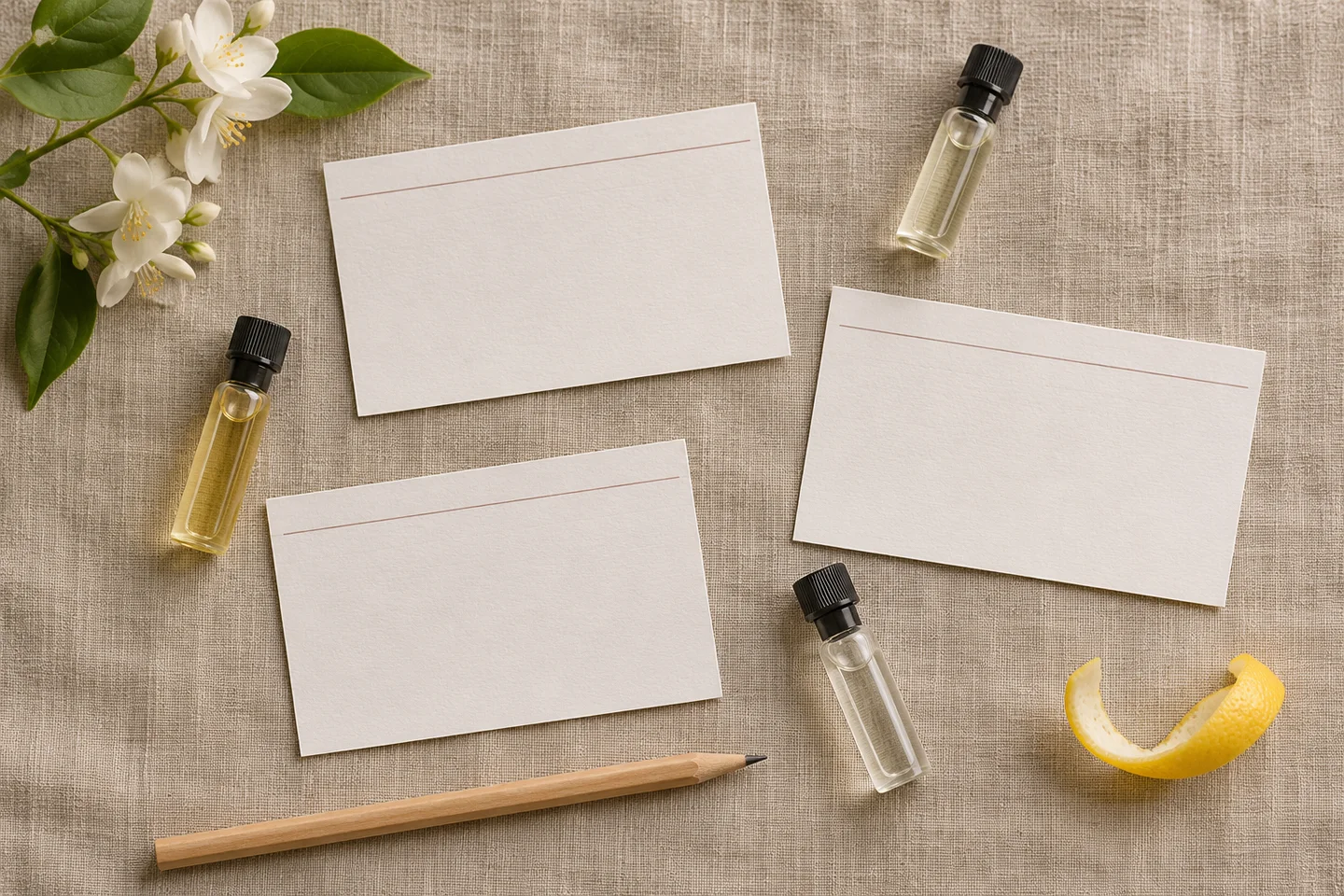
When a familiar perfume leaves you searching for words, try three prompts in a notebook. What does this remind me of? Which words would help me recognize my own impression later? Would I want to wear it during the part of the day I am considering? The prompts are editorial suggestions for organizing your decision, rather than a clinical or laboratory assessment.
A naming study shows why the cue matters
In a 2025 peer-reviewed odor-naming study, 40 Turkish-speaking volunteers aged 18–32 smelled selected odors from a standardized pen set. They then saw either relevant color cues or fragments of the odor names. The researchers measured naming performance and recorded EEG activity. Letter cues supported more accurate identification than the color cues in that task.
The findings concern a defined odor set, language, group and cue sequence. Both cue types carried relevant information, and the study did not test whether reading a perfume's marketing notes improves a customer's purchase. The paper's brain-connectivity analysis also should not be treated as a measure of perfume quality.
For your own notes, record when you consulted the description. A word written before reading and a word adopted afterward have different histories. You can keep both, with the second marked as a prompted interpretation. This preserves something useful about how you reached your answer.
A rose impression is still an impression
When describing a familiar perfume, material vocabulary adds another layer. The PubChem record for 2-phenylethanol describes a rose-like odor. That is a description of a named chemical material. Recognizing a rosy aspect in a complete perfume does not identify that material, its amount or its source in the formula.
Use a word such as rose to communicate an impression when it helps. If you are making an ingredient record, copy the actual package declaration instead. A note list, your sensory words and the ingredient declaration serve different purposes. Keep each attached to its source.
For more context, read how to understand a blended perfume smell and how to read fragrance notes. Those guides help connect a whole-fragrance impression with the words used to discuss it.
A memory link needs a separate note
A study in the January 2026 issue of iScience examined 106 participants who encountered odors in visual and spatial contexts and returned for memory testing 24–72 hours later. Its protocol distinguished recognizing an encountered odor from retrieving an associated episode. The analysis found different predictors for those processes, including features of the verbal descriptions.
The task involved experimentally arranged episodes. It does not establish that a particular perfume will recover a personal memory or work the same way for every wearer. Its value here is a careful distinction between recognizing a scent and recalling something associated with it. Both can matter to your record without being interchangeable.
If a familiar perfume reminds you of an older bottle, write the association as a possibility. A memory can suggest what to compare next. Confirm the full product name and version before using the association to place an order. Similar memories alone do not establish that two products share a formula.
Keep simple notes for a familiar perfume

When you revisit a familiar perfume, start with one sample and a short entry in your own words. Follow its directions and use a setting where fragrance is appropriate. Write the date, the exact product name and the point in your routine when you noticed the impression. Leave the official description until after that first entry if you want to preserve an unprompted record.
Later, add what the listing says and which parts you want to investigate again. On another suitable day, return to the same question. You may keep the original word, replace it with something clearer or decide that the whole fragrance matters more to you than naming one aspect.
For future research, comparisons across languages, odor sets and more natural sampling settings would help clarify how well a cueing result travels beyond its original task. That remains a research question. Your shopping decision can stay simpler. Keep the description that you understand, the context you would wear it in and the uncertainty you still want a sample to resolve.
Explore the independent inspired fragrance catalog once you have a useful personal brief. Read each product's own description and format. Check your product choices and shipping charge in the cart before checkout.
Sources and editorial notes
The naming study was published December 2, 2025. The memory paper appeared online in December 2025 and in the January 16, 2026 issue of iScience. These are dated research examples checked November 19, 2026, rather than announcements of new work this week. PubChem supports the chemical-name example. The notebook routine is editorial guidance and contains no personal wear-test claims.
Prepared November 19, 2026 by Fragrentis Editorial Team.