
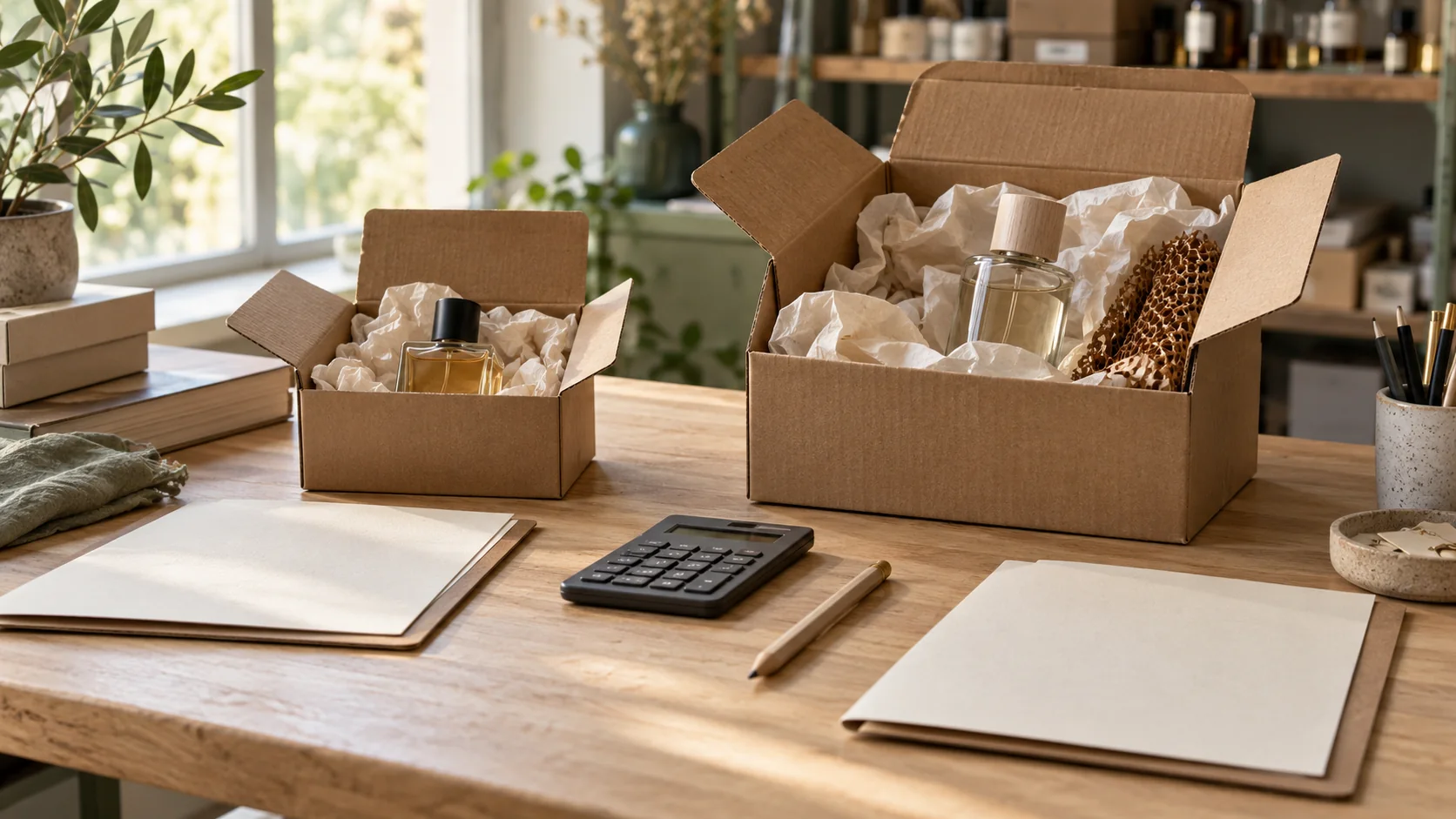
Compare wholesale fragrance quotes using a 24-bottle trial and a 48-bottle order. Separate supplier evidence, landed cost, contribution and cash tied up in unsold stock.
A supplier offers a lower bottle price if you double the order. The saving is real on paper. The harder question is whether the extra stock deserves the extra cash today.
For a small fragrance shop, comparing suppliers involves two separate decisions. First, are the goods and terms acceptable? Second, does the order fit the business’s cash position? A tidy spreadsheet cannot rescue an unclear product identity. Equally, a reliable supplier can still offer a quantity that is too large for your first test.
This guide uses a deliberately invented 24-bottle versus 48-bottle comparison. The numbers are not Fragrentis prices, supplier quotations, market averages or a sales forecast. Use the method with your own written quotes and actual costs.
Start with comparable wholesale fragrance quotes
Send each supplier the same short request. Specify the exact products, bottle sizes, quantities, delivery destination and proposed order date. If you need a mixed assortment, ask for the price of that particular mix. A minimum that applies separately to each scent can create a very different commitment from a minimum across the whole order.
Ask the supplier to separate product charges, inbound delivery and any other quoted charges. Record which expenses are excluded or still unknown. If duties or other destination charges apply to your purchase, obtain the figures for your circumstances rather than treating an international quote as a domestic delivered price.
A useful comparison sheet has a column for the question, a column for each supplier’s answer and a final column for evidence still missing. Keep the original email or quotation with its date and validity period. Write “not confirmed” in an empty field. A blank cell otherwise has a habit of turning into a zero when someone totals the order.
Confirm when payment is due and when dispatch is expected. A dispatch estimate is different from a promised arrival date. If a lead time depends on a product becoming available, make that condition visible in the comparison.
Product identity comes before the price calculation
What will arrive in the box? Separate original designer goods, independent fragrances, private-label products and inspired alternatives. Ask for the exact product name, manufacturer or supplier identity, packaging information, bottle size and photographs of the item being quoted. Do not infer authorization from a familiar scent name or an attractive bottle photograph.
Request an example of the paperwork provided with the order and the process for reporting an incorrect item, shortage or damage. Ask whether a sample represents the same product offered in the larger order. These questions establish a paper trail; they do not certify a supplier or prove a product claim on their own.
The FTC’s small-business advertising guidance explains that advertising claims need support and must not mislead. In practical terms, a retailer needs evidence for what its own listing promises. Therefore, a supplier’s enthusiastic description is a prompt to investigate, not a ready-made statement to repeat unchanged.
Treat unresolved identity or material specification questions as a reason to pause that quote. Do not award extra points for a low price that depends on assumptions about what the product is.
Compare the whole commitment, not the unit-price headline
Here are two hypothetical domestic US-dollar quotes. Assume the bottles are otherwise acceptable, there are no additional inbound charges in this particular example, and the full order must be paid before dispatch. Actual purchases need their own complete cost list.
| Comparison | Quote A | Quote B |
|---|---|---|
| Bottles required | 24 | 48 |
| Product price per bottle | $18.00 | $16.00 |
| Product subtotal | $432.00 | $768.00 |
| Inbound delivery | $48.00 | $72.00 |
| Total initial cash payment | $480.00 | $840.00 |
| Landed cost per bottle in this example | $20.00 | $17.50 |
The landed cost is the product subtotal plus the stated inbound delivery, divided by the number of bottles. Quote B saves $2.50 per bottle under these assumptions. It also requires $360 more cash upfront and leaves you responsible for selling 24 additional bottles.
Neither fact cancels the other. Quote B may suit a shop with demonstrated demand and enough working cash. Quote A may be a useful smaller experiment. The comparison becomes clearer when the decision is written as “spend another $360 to carry another 24 bottles,” rather than simply “save $2.50.”
Do not assign all the delivery cost to the first bottle sold or forget it because it appears on another invoice. For mixed sizes or products, equal allocation per bottle is only a simplifying choice. Use a sensible, documented allocation when weight, value or handling makes the actual cost pattern different.

Margin and cash answer different questions
Assume a retail selling price of $40 per bottle and these invented costs for each completed one-bottle order: $2 packing, $2 payment processing and $5 outbound delivery. That is $9 per order beyond the landed bottle cost. Fees are assumptions, not quotes from a payment provider or delivery service. Advertising, refunds, taxes, financing and fixed expenses are not included yet.
| At the assumed $40 selling price | Quote A inventory | Quote B inventory |
|---|---|---|
| Landed cost of the bottle sold | $20.00 | $17.50 |
| Gross profit per bottle | $20.00 | $22.50 |
| Gross margin: gross profit ÷ sales | 50.00% | 56.25% |
| Other assumed order costs | $9.00 | $9.00 |
| Contribution before omitted costs | $11.00 | $13.50 |
Track cash alongside sales margins
Those margins describe the modeled sale, not money available to withdraw. Now suppose only 12 bottles sell during the first 30 days and all customer payments clear during that period. Sales receipts are $480; the assumed packing, processing and outbound costs total $108. That leaves $372 toward recovering the initial inventory payment.
With Quote A, the cash movement from this purchase-and-sales cycle is $372 minus $480, or negative $108. With Quote B, it is $372 minus $840, or negative $468. This is before the omitted costs. The same sales pace leaves a larger amount of cash tied up in the larger order.
Meanwhile, the modeled contribution from those 12 sales is positive: $132 with A and $162 with B. There is no contradiction. You paid for unsold stock as well as sold stock. A still has 12 bottles with an allocated inventory cost of $240; B has 36 with a cost of $630. Inventory is not the same as cash in the bank, and its cost is not a promise of its future selling value.
Keep a cash sheet and a sales-margin sheet alongside each other. In this simplified model, the full purchase payment belongs in the cash sheet, while the landed cost of the units sold enters the margin calculation. Subtracting the whole inventory purchase again from that margin would mix the two views and double-count part of the cost.
Check the sales pace the saving needs
Start with observed completed sales if the shop has them. For a new assortment, use several clearly labeled scenarios rather than presenting your preferred number as a forecast. In the example, try six, 12 and 24 sales in the first month. Each scenario should show the bottles remaining, cash committed and contribution before omitted costs.
Then test one assumption that could change the decision: a lower realized selling price, higher delivery cost or additional advertising expense. At a $36 selling price with the other modeled costs unchanged, contribution falls to $7 for A and $9.50 for B. A discount changes the cash recovered from each sale even when the supplier price stays fixed.
For a separate illustration, suppose monthly fixed expenses are $330 and the original $40 sale assumptions apply. Divide fixed expenses by unit contribution to model the break-even quantity. For A, $330 ÷ $11 = 30 bottles. With B, $330 ÷ $13.50 requires rounding up to 25 bottles. For further business-finance exercises, the FDIC’s Money Smart for Small Business includes financial-management training. This is an estimate using specified costs, not a guarantee or a calculation of how quickly the original purchase cash returns.
Notice that A’s 24-bottle first order cannot supply 30 sales without replenishment. However, a reorder may have a different freight allocation or price. Update the model before extending the example to a whole month or several orders. Likewise, include actual advertising, expected return costs and every other relevant expense before using the calculation to judge viability.
Put receiving and problem resolution in writing
Before paying, agree on how an issue is documented and who receives the report. Ask about the reporting window, information required, and available remedies. A vague promise to “take care of it” is difficult to compare with a written procedure explaining replacement, credit or refund conditions.
At receipt, compare the goods with the confirmed list: SKU or product identifier, quantity, size, packaging and visible condition. Record discrepancies before making the inventory available for sale. Keep the order paperwork and photographs together so that a later question can be traced to the right delivery.
Confirm that the proposed transport service accepts the particular shipment and that any required packaging and documentation are addressed. For US postal shipments, consult the current USPS Publication 52 and the applicable product classification. This guide is not a shipping clearance and does not assume every fragrance can travel by the same service.
Make the first order a bounded experiment
Write down what the order is supposed to teach you before selecting its size. You might be checking whether a particular assortment attracts repeat orders, whether descriptions answer customers’ questions, or whether receiving and dispatch fit your available time. “Buy as much as the budget permits” gives no useful test to evaluate afterward.
Set a review date and a cash limit. Keep enough money available for expenses the purchase does not cover. If a supplier offers a larger-order saving, ask whether it remains available on a later reorder rather than assuming today’s offer is your only chance. The answer may be no; knowing that is still better than inventing urgency for yourself.
A compact decision note can contain five lines:
- Exact products and quantities accepted, with unresolved questions listed.
- Total cash payment and when it is due.
- Modeled contribution at the normal price and one lower-price scenario.
- A sales-pace assumption, remaining-stock calculation and cash reserve.
- The next review date, receiving procedure and reorder conditions to verify.
This makes a future comparison possible. You can look back at the assumptions and compare them with actual sales, costs and supplier performance instead of judging the purchase only by how encouraging it felt when the quote arrived.
Where Fragrentis fits
If you are exploring the assortment available from our store, browse the Fragrentis collection and verify the current product details and ordering terms before making your own comparison. Fragrentis offers independent inspired alternatives, not original designer-brand perfumes. The hypothetical quotes and costs above describe neither our prices nor our supplier terms.
Published by Fragrentis, which operates the linked store and the related journals below. This is an editorial planning guide, not a supplier certification, personal sales case study or profit promise.
Sources and editorial notes
- FDIC: Money Smart for Small Business, financial-management learning resources; checked October 15, 2026.
- Federal Trade Commission: Advertising FAQs for Small Business, checked October 15, 2026.
- USPS Publication 52: Hazardous, Restricted, and Perishable Mail, current online reference checked October 15, 2026; shipment-specific rules still need verification.
All figures are invented US-dollar teaching examples. Calculations and linked sources were reviewed by Codex editorial checks on October 15, 2026; this does not imply review by a human financial adviser. Illustrations were generated with AI and show generic objects, not actual Fragrentis stock or supplier evidence. No Fragrantica images or community ratings are used in this business article.